
4K60 PTZ Conference Camera with NDI & AI Auto-Tracking
A 4K60P pan-tilt-zoom camera built for lecture capture, large rooms and live streaming. An 8.42-megapixel UHD sensor and 20× optical zoom, with NDI®|HX2, single-lens AI auto-tracking and uncompressed HDMI / 3G-SDI — HDMI/SDI, USB and IP all running at the same time.
Written for system integrators and project companies putting a PTZ camera into a specification or a room BOM. Every parameter below is published in full, so you can match it against whatever document you are working from.
How this camera is usually specified
A PTZ camera gets described through the same handful of parameters wherever the document comes from. This is that list, with the T-VID-CAM-4K value against each one and a note on what usually goes wrong when the line is written. It is a reference for whoever has to put the camera on paper — not a claim about any particular document.
| Parameter | T-VID-CAM-4K | What to watch when you write the line |
|---|---|---|
| Camera type | PTZ camera with on-board AI auto-tracking | Tracking runs on the camera itself, so no external tracking appliance or operator PC belongs in the BOM. |
| Tracking mode | Single-lens humanoid presenter tracking | Presenter tracking is on board. Zone-based tracking is a different feature and we confirm it against the firmware build rather than assume it — send the wording and we will answer before you quote. |
| Image sensor | 1/1.8-inch UHD CMOS, 8.42 MP effective | Sensor size is written as a fraction, and a smaller denominator means a physically larger sensor. 1/1.8-inch is larger than the 1/2.8-inch found on most Full HD PTZ cameras, including our own. |
| Resolution and frame rate | 4K 3840×2160 at up to 60fps; down-compatible 1080p / 720p | State the frame rate as well as the resolution. A camera that reaches 4K only at 30fps is a different product. |
| Optical zoom | 20× optical (f = 6.25–125 mm, F1.58–F3.95), 16× digital | Specify optical zoom, not combined zoom. Digital zoom crops the sensor and does not help in a deep hall. |
| Field of view | Horizontal 60° at the wide end, narrowing to 3.5° | A zoom lens has a range, not one number. If a line quotes a single angle, it almost always means the widest setting. |
| Video compression | H.265 / H.264 / MJPEG, dual stream | Main stream to 3840×2160, sub stream to 720×480, VBR or CBR. Worth naming when the recording server and the live stream need different bitrates. |
| Streaming protocols | SRT, RTSP, RTMP/RTMPS, Onvif, multicast; NDI®|HX2 as a factory option | See the note on factory options below before naming NDI in a requirement. |
| Simultaneous outputs | HDMI/SDI + USB + IP — three high-definition digital signals at once | This is the line that removes a second camera from a lecture-capture BOM. Many cameras output one signal at a time, so it is worth writing explicitly. |
| Uncompressed output | HDMI 2.0 and 3G-SDI | 3G-SDI stays usable to about 150 m at 1080P30, which is what decides the cable route in an auditorium. |
| USB output | USB 2.0, UVC 1.1–1.5, with UVC PTZ control; H.264/H.265 to 2160P30 | See the note on USB below. Plug-and-play on the common soft-codec platforms with no driver. |
| Control | VISCA / Pelco-D / Pelco-P over RS-232, RS-485, IP and USB; network VISCA | RS-485 runs to 1200 m, RS-232 to 30 m. If a control system is in the same package, this is the row the AV consultant reads first. |
| Presets | 255 presets, 0.1° accuracy | Well above the number normally asked for. Preset accuracy matters more than preset count in a recorded room. |
| Power | PoE+ (802.3at) or DC 12V, 18 W maximum | See the note on PoE below. The PoE switch is supplied by the integrator and is not in the Tralltech BOM. |
| Operating temperature | 0 °C to 40 °C | See the note on site conditions below. |
| Certifications and warranty | CE · FCC · RoHS; 2 years from shipment date | Certificates issued on request for inclusion in a bid. We manufacture the camera, so manufacturer authorisation letters and factory inspection are both available. |
Four things to check before you commit to a price
None of these stop the camera being specified. All four cost money or time if they are found after the order.
It needs PoE+, not plain PoE
802.3at, not 802.3af. The camera draws up to 18 W, which is more than an 802.3af switch can deliver — it will not run on one. Either put a PoE+ switch in the network section of the bid or power the camera locally from DC 12V. This is one of the most common delivery-day failures on a project, and it is a network line item, not a camera line item.
The USB port is 2.0, not 3.0
Compressed 4K30 over UVC. It works as a plug-and-play camera on the common soft-codec platforms and carries H.264/H.265 up to 2160P30. If a requirement says USB 3.0, or asks for uncompressed video over USB, this camera does not answer it — use HDMI 2.0 or 3G-SDI for uncompressed feeds, which run at the same time as USB anyway.
NDI®|HX2 is a factory option
Specified at time of order. A stock unit does not ship with it. SRT, RTSP, RTMP and Onvif are standard and cover most streaming and recording servers, so check whether the requirement is really NDI or just low-latency IP video. The gravity sensor for automatic image flip is a factory option on the same basis.
Standard build is rated 0–40 °C
Check the room, not the datasheet. An unconditioned hall in a hot climate can sit above 40 °C for part of the day. If that describes the site, raise it with us at design stage rather than after delivery — it is a solvable problem when there is still time to solve it.
This camera is one line in a room. For the rest of the BOM, the topology and the engineering rules that go with it, see the video conference room solution we design for integrators.
Uncompressed output, three signals at once
The most common system-integration question with a PTZ camera is “which output do I use?” The T-VID-CAM-4K sends HDMI 2.0, 3G-SDI and IP/LAN plus USB — three high-definition digital signals at the same time, with HDMI 2.0 and 3G-SDI both carrying uncompressed video for professional recording.
| Output | Best used for | What it delivers |
|---|---|---|
| HDMI 2.0 | Display · hardware codec · matrix | Uncompressed digital video up to 4K60P |
| 3G-SDI (BNC) | Long cable runs · pro AV | Uncompressed video, effective up to 150 m at 1080P30 |
| IP / LAN (PoE+) | NDI / SRT recording & streaming | Network video up to 3840×2160 over one PoE+ cable |
| USB 2.0 (UVC) | Zoom · Teams · Google Meet | UVC webcam with PTZ control (H.264/H.265 up to 2160P30) |
Full HD or 4K — choosing the right PTZ
Tralltech offers two PTZ conference cameras with the same 20× optical zoom and motorised head. Most standard meeting rooms are well served by the Full HD model — step up to this 4K model for lecture capture, AI auto-tracking, IP streaming and large halls.
| T-VID-CAM · Full HD | T-VID-CAM-4K · this model | |
|---|---|---|
| Sensor | 1/2.8-inch 5 MP | 1/1.8-inch 8.42 MP UHD |
| Max resolution | 1080P60 | 4K (3840×2160) 60fps |
| Streaming | IP/LAN | NDI®|HX2 (option) · SRT · RTMP |
| AI auto-tracking | — | Yes, single-lens |
| Uncompressed out | — | HDMI 2.0 & 3G-SDI |
| Best for | Meeting rooms, boardrooms | Lecture capture, auditoriums, streaming |
Built to record, track and stream
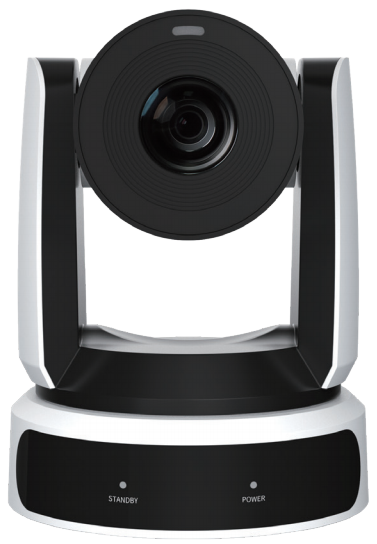
The T-VID-CAM-4K pairs a 1/1.8-inch 8.42-megapixel UHD CMOS sensor with a 20× optical zoom lens (60° wide field of view) and a self-developed motorised pan-tilt head. It captures true 4K (3840×2160) at up to 60fps and is down-compatible with 1080p and 720p.
Specification documents call this device several different things — PTZ camera, PTZ AI auto-tracking camera, ePTZ camera, video conference camera, auto-tracking camera, lecture capture camera. They all describe the same class of product, and this page is written so that whichever wording is in front of you, the parameters still line up.
Its defining strengths are network video and automation — NDI®|HX2 and SRT for low-latency IP streaming, on-board single-lens AI auto-tracking that keeps a presenter framed without an operator, and uncompressed HDMI 2.0 / 3G-SDI output for professional capture — so one camera covers the call, the recording and the live stream at once.
- True 4K60P1/1.8-inch 8.42MP UHD CMOS, down-compatible 1080p/720p
- 20× optical + 60° wide4K telephoto lens, 16× digital zoom
- NDI®|HX2 streamingLow-latency plug-and-play IP video (factory option)
- AI auto-trackingSingle-lens humanoid tracking follows the presenter
- Uncompressed outputHDMI 2.0 & 3G-SDI for professional recording
- Precise PTZ±170° pan, -30° to +90° tilt, 255 presets at 0.1°
- Low-light & clean image0.5 Lux, 3D noise reduction, SNR ≥ 55 dB
- Broadcast controlVISCA / Pelco-D/P over RS-232, RS-485, IP & USB
Full technical specifications
| Image sensor | 1/1.8-inch UHD CMOS, 8.42 MP effective |
| Max resolution | 4K (3840×2160) at up to 60fps; down-compatible 1080p / 720p |
| Scan mode | Progressive |
| Optical zoom | 20× (f = 6.25–125 mm, F1.58–F3.95) |
| Digital zoom | 16× |
| Field of view | Horizontal 60°–3.5°; vertical 35.7°–2.0° |
| Minimum illumination | 0.5 Lux (F1.8, AGC on) |
| Shutter | 1/30 s – 1/10000 s |
| White balance | Auto / indoor / outdoor / one-key / manual / VAR |
| Noise reduction | 3D digital noise reduction |
| Backlight compensation | Supported |
| Signal-to-noise ratio | ≥ 55 dB |
| Image flip / freeze | Supported (gravity sensor for auto flip is a factory option) |
| HDMI 2.0 output | Uncompressed; up to 4K60/59.94/50/30/29.97/25, 1080P, 1080I, 720P |
| 3G-SDI output | BNC, 800 mVp-p, 75 Ω, SMPTE 424M; uncompressed up to 1080P60; effective to 150 m at 1080P30 |
| USB output | USB 2.0 (UVC 1.1–1.5), UVC PTZ control; H.264/H.265 up to 2160P30, MJPEG up to 2160P30 |
| IP / LAN output | RJ45 10/100/1000M; network video up to 3840×2160 |
| Simultaneous output | HDMI/SDI + USB + IP — three high-definition digital signals at once |
| Audio | 3.5 mm line in + 3.5 mm line out; embedded on HDMI / LAN / USB |
| Video compression | H.265 / H.264 / MJPEG |
| Streams | Dual stream — main up to 3840×2160; sub up to 720×480 |
| Bitrate | Main 32 kbps–51,200 kbps; sub 32 kbps–20,480 kbps; VBR / CBR |
| Frame rate | 50Hz: 1–50 fps; 60Hz: 1–60 fps |
| Audio | AAC, 96 / 128 kbps |
| Protocols | SRT, RTSP, RTMP / RTMP(s), Onvif, TCP/IP, HTTP, DHCP, multicast; NDI®|HX2 as a factory option |
| USB OS support | Windows 7/8/10/11, macOS 11.6.6+, Ubuntu 18.04.4 LTS+, Android 8.0.0+ |
| Pan range | ±170°, speed 1.7°–100°/s |
| Tilt range | -30° to +90°, speed 1.7°–69.9°/s |
| Presets | 255, accuracy 0.1° |
| Drive | Self-developed mechanical motorised PTZ |
| Control interfaces | RS-485 (Phoenix, ≤1200 m), RS-232 in/out (mini-DIN, ≤30 m), IP, USB |
| Control protocols | VISCA / Pelco-D / Pelco-P; network VISCA |
| Power | DC 12V or PoE+ (802.3at) — 802.3af is not sufficient; 2A max, 18 W max |
| Operating temperature | 0 °C to 40 °C |
| Dimensions / weight | 169 × 142 × 175 mm / 1.5 kg |
| Certifications / warranty | CE · FCC · RoHS / 2 years from shipment date |
Part of a complete capture & conference system
The T-VID-CAM-4K is built to integrate with the rest of the Tralltech range. Common pairings:
Designed into our solutions
Lecture capture & hybrid teaching
AI auto-tracking follows the teacher while SRT or NDI feeds the recording and streaming server — for recorded classrooms and hybrid lessons.
Explore the Smart Classroom solutionAuditoriums & large rooms
4K60 with 20× zoom and 255 presets covers every seat; USB UVC connects to soft-codec platforms, with uncompressed SDI/HDMI for broadcast.
Explore the Video Conference solutionFrequently asked questions
What if the tender asks for a specification this camera does not meet?
Send us the clause and we answer plainly. There are three outcomes and we will tell you which one applies: the specification can be met by a custom build, because we are the factory and the camera is our own product; or a different model in the range matches the wording better; or the clause is written around one supplier's data sheet and your route is to argue it as equivalent or superior, in which case we supply the technical justification you attach to the bid. We would rather tell you before you quote than after you have committed a price.
Our tender specifies a 1/2.8-inch CMOS sensor. Can we still bid this camera?
Yes, and it is worth understanding why. A 1/1.8-inch sensor is physically larger than a 1/2.8-inch sensor, so the T-VID-CAM-4K exceeds that line rather than missing it, which is normally accepted under an equivalent or superior provision. If the evaluation is being read strictly to the letter, the Full HD T-VID-CAM uses a 1/2.8-inch 5 MP sensor and matches the wording exactly, so the choice between the two models is a bid strategy decision, not a technical dead end.
Does the camera need a PoE+ switch, or will a standard PoE switch work?
It needs PoE+ (802.3at). The camera draws up to 18 W, which is more than plain 802.3af PoE can deliver, so an 802.3af switch will not run it. Either specify a PoE+ switch in the network section of the bid, or power the camera locally from DC 12V. The switch is supplied by the integrator and is not part of the Tralltech BOM, and this is one of the most common delivery-day problems on a project, so it is worth confirming during the design stage rather than on site.
What is the difference between the 4K (T-VID-CAM-4K) and Full HD (T-VID-CAM) PTZ camera?
Both share a 20x optical zoom and a motorised pan-tilt head. The Full HD T-VID-CAM uses a 5MP sensor with 1080P60 output and SDI, HDMI, IP and USB output, suited to standard meeting rooms. The 4K T-VID-CAM-4K uses an 8.42MP UHD sensor with 4K60P output and adds SRT streaming, AI auto-tracking, uncompressed HDMI and SDI, and NDI HX2 as a factory option, which makes it the model for lecture capture, auditoriums and live streaming.
What is NDI HX2 and why does it matter for a PTZ camera?
NDI HX2 is a low-latency, plug-and-play IP video standard that sends audio, video and control commands together over a standard network. On the T-VID-CAM-4K it lets a recording or streaming server receive the 4K feed over a single LAN cable, which simplifies wiring in classrooms and large rooms compared with running separate video cables. It is a factory option specified at time of order, so if a tender clause names NDI it must be stated on the purchase order rather than assumed.
How does the AI auto-tracking work?
The camera carries an on-board AI chip running single-lens humanoid tracking. It detects and follows the presenter automatically, keeping them framed without a camera operator, which is what makes unattended lecture capture practical. If a specification also calls for zone-based tracking, send us the exact wording so we can confirm it against the firmware build before you quote.
Can the 4K PTZ camera be used with Zoom and Microsoft Teams?
Yes. The T-VID-CAM-4K has a USB 2.0 UVC output with UVC PTZ control, so it connects as a standard camera for Zoom, Microsoft Teams, Google Meet and other soft-codec platforms. Note that the port is USB 2.0 rather than USB 3.0, and it carries compressed video up to 2160P30. For uncompressed feeds use HDMI 2.0 or 3G-SDI, which can run at the same time as the USB and IP outputs.
What outputs does the camera have, and can they run at the same time?
It provides HDMI 2.0 up to 4K60P, 3G-SDI, IP over LAN and USB. It outputs three high-definition digital signals simultaneously, and both HDMI 2.0 and 3G-SDI carry uncompressed video for professional recording. In practice this means one camera can feed a live call and a recording server at the same time, which removes a second camera from the room BOM.
How is the camera powered and controlled?
The T-VID-CAM-4K runs on PoE+ (802.3at) over the LAN cable or on DC 12V, drawing up to 18 W. It is controlled via RS-232, RS-485, IP or USB using the standard VISCA, Pelco-D and Pelco-P protocols, with an infrared remote included. RS-485 runs to 1200 m and RS-232 to 30 m, which is usually the deciding factor when the control room is not next to the hall.
Specify the T-VID-CAM-4K in your next project
Send us the camera clause from your specification and we will tell you which lines this model answers, which need a custom build, and which are worth arguing as equivalent or superior. We respond within 24 hours.
Guangzhou Tralltech Technology Co., Ltd. is a smart classroom and video conferencing system manufacturer — designing and producing interactive flat panel displays and complete classroom and conference-room equipment, and helping system integrators and project companies deliver complete projects worldwide.
Written by the Tralltech Technical Team · Last reviewed: September 2026