
UHF Wireless Microphone Systems for Classrooms & Conference Rooms
True-diversity UHF wireless microphone systems for smart classrooms and meeting rooms — available as single-channel (handheld, headset or lapel) and dual-channel sets, with up to 200 m range and line-level output for clean integration with your interactive flat panel.
Written for system integrators and project companies putting a microphone system into a room design or a bill of materials. Full parameters are published below, including the four things that most often go wrong between order and handover.
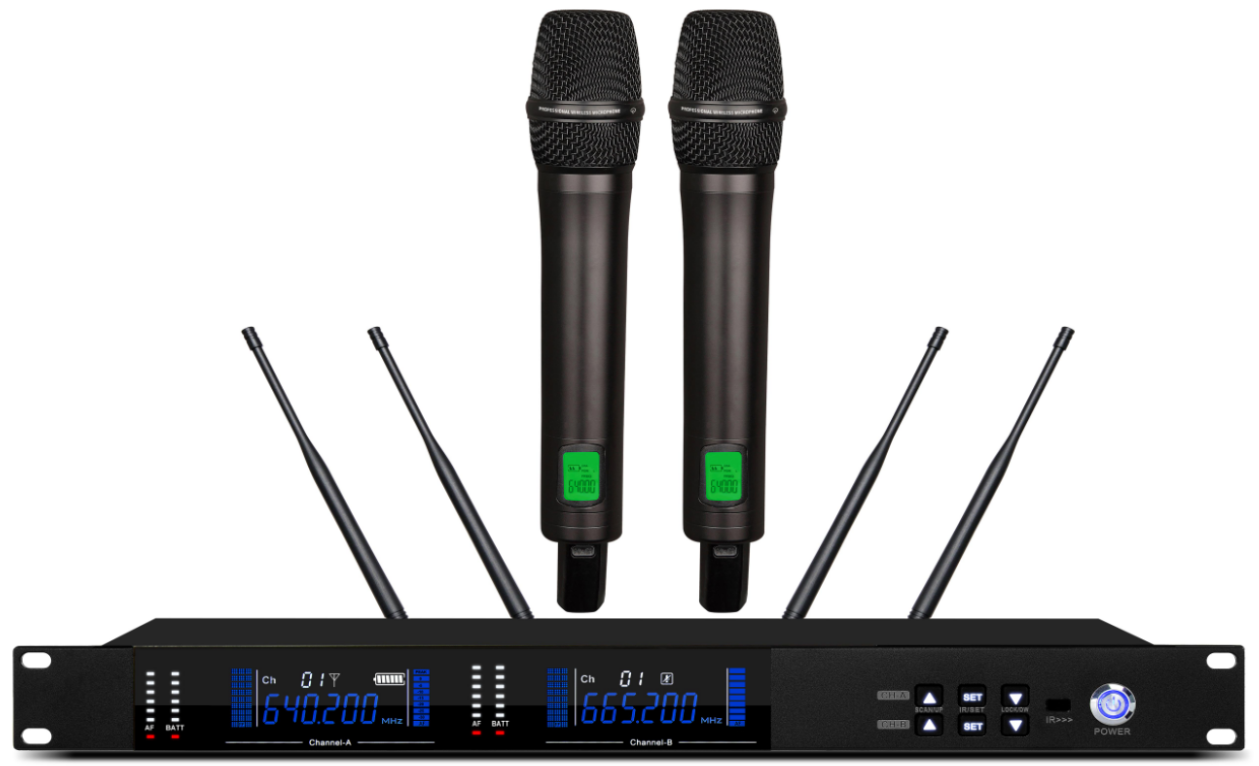
How a Wireless Microphone System Is Usually Specified
A wireless microphone gets described through the same handful of parameters wherever the document comes from. This is that list with the T-AUD-MIC values against each one, and a note on what usually goes wrong when the line is written.
| Parameter | T-AUD-MIC | What to watch when you write the line |
|---|---|---|
| Frequency band | UHF. Single-channel 612–850 MHz (default 612–698); dual-channel 500–980 MHz depending on model | See the first note below. This is the line that decides whether the shipment is legal in the destination country. |
| Number of channels | Single-channel set (1 mic) or dual-channel set (2 independent mics) | Count live microphones, not people. Two presenters who never speak at the same time still need two transmitters if both are wearing one. |
| Reception | True diversity, dual antenna, independent per channel | Worth naming explicitly. Single-antenna receivers are cheaper and drop out when a teacher walks behind a column. |
| Selectable channels | 45 per band (single-channel); up to 200–300 with infrared pairing (dual-channel) | Matters when many rooms in one building run at once. See the note on simultaneous systems below. |
| Microphone type | Handheld, headset, lapel / tie-clip, desktop gooseneck | Requirements are often written as a room type rather than a mic type. A lecture hall usually means headset or lapel; a boardroom usually means gooseneck or boundary. |
| Capsule | 110 Ω low-impedance dynamic, interchangeable head | If a requirement names a polar pattern (cardioid, omnidirectional) or a boundary microphone, send us the wording — we confirm the available capsule against it rather than assume. |
| Audio response | 60 Hz–15 kHz ±3 dB (single-channel); 40 Hz–18 kHz ±3 dB (dual-channel) | Speech intelligibility lives between roughly 100 Hz and 8 kHz, so both are comfortably adequate for a classroom. |
| Signal-to-noise ratio | ≥89 dB (single-channel); >105 dB composite (dual-channel) | — |
| Receiver audio output | Balanced. Single-channel 0–300 mV / 600 Ω; dual-channel +10 dB (2.5 V) / 600 Ω balanced, +4 dB (1.25 V) / 5 kΩ unbalanced | See the second note below. The two sets do not put out the same level, and that changes the gain structure downstream. |
| Operating range | 200 m open air; up to 500 m with external antenna (single-channel); 300 m long-range version (dual-channel) | These are open-air figures. Indoors, walls and RF congestion cut them substantially — which is still far more than any single room needs. |
| Transmitter RF power | 10 mW (single-channel); selectable up to 15 mW (long-range dual-channel) | Some countries cap permitted transmit power. It is checked at the same time as the band. |
| Receiver power | DC 12 V / 1000 mA switching adapter, 1U rack-mountable metal chassis | See the fourth note below. The receiver is not powered over the network. |
| Transmitter power | 2× AA, ≤130 mA; rechargeable handheld option available | See the third note below. |
| Operating temperature | −10 °C to +40 °C | Adequate for an unconditioned classroom in most climates. Raise it with us if the site regularly runs hotter. |
| Certifications & warranty | CE · FCC · RoHS; 2 years from shipment date | Certificates issued on request for inclusion in a bid. We manufacture, so manufacturer authorisation letters are available. |
Four Things to Check Before You Commit to a Price
None of these stop the system being specified. All four cost money or time if they are found after the order.
The UHF band has to match the destination country
This is the one that stops a container. Every country allocates UHF spectrum differently, and some of the band is reserved for broadcast or public services. A receiver tuned to a band that is not permitted locally may be held at customs, and even if it clears, it can be unusable next to a local TV transmitter. Bands are configured at the factory per destination market — tell us the country before the order is placed, not after. If you are bidding into a market we have not shipped to before, send us the regulator's allocation table and we will confirm what we can supply.
The two sets do not output the same level
Single-channel is 0–300 mV; dual-channel reaches 2.5 V balanced. Standard line level sits around 1 V, so a single-channel receiver feeding a device that expects line level will need gain applied downstream at the panel, mixer or amplifier. It is not a fault and it is easily handled — but it has to be handled at commissioning rather than discovered when the room sounds quiet on handover day. If the room design is fixed around a specific input sensitivity, tell us and we will confirm the match.
Transmitters run on AA batteries
2× AA per transmitter, per room. On a single room that is nothing. On a fifty-classroom rollout it is a consumables line that nobody puts in the budget and the end client discovers three months in. A rechargeable handheld option is available — raise it at design stage if the client has no procurement route for batteries, which is common on donor-funded and rural projects.
The receiver needs mains power and rack space
DC 12 V adapter, 1U metal chassis. It is not powered over the network, so a socket has to exist wherever the receiver sits. In a lectern or a rack that is usually fine; on a wall-mounted panel installation it is a line item the electrician needs to know about. Where the receiver sits far from the room, the removable antenna and 9 V feed allow an external antenna or booster.
This microphone is one line in a room. For the rest of the audio chain, the topology and the engineering rules that go with it, see the complete smart classroom system we design for integrators.
Which Configuration for Which Room
Requirements are normally written as a room, not as a microphone. This is how the rooms map onto the range.
Choose Your Configuration
One platform, two configurations. Pick the single-channel set for a teacher or presenter, or the dual-channel set when two microphones are needed at once.
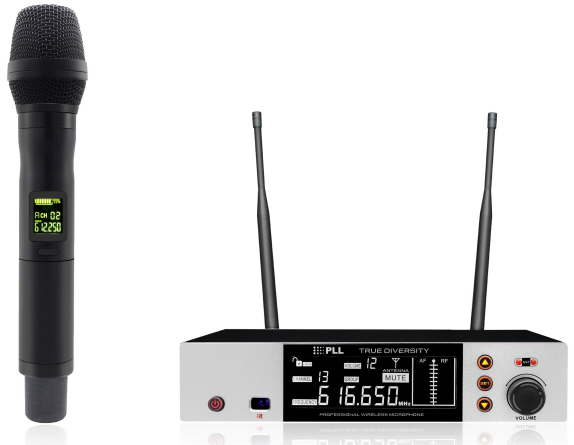
T-AUD-MIC-S
One transmitter, true-diversity reception. The everyday classroom choice for a single teacher or presenter.
- Handheld — lectures, Q&A, events
- Headset — hands-free teaching & demos
- Lapel / Tie-clip — discreet all-day wear
- UHF 612–850 MHz · up to 200 m open range
T-AUD-MIC-D
Two independent channels in one receiver — for co-teaching, panels, and conference rooms. Mix handheld, headset or lapel on either channel.
- 2× independent channels, true diversity
- Infrared one-touch frequency pairing
- Standard 200 m / Long-range 300 m options
- Feedback howl suppression built in
| Feature | Single-Channel (T-AUD-MIC-S) | Dual-Channel (T-AUD-MIC-D) |
|---|---|---|
| Microphones included | 1 | 2 (independent) |
| Mic configurations | Handheld / Headset / Lapel | Any mix of Handheld / Headset / Lapel / Gooseneck |
| Frequency band | UHF 612–850 MHz (default 612–698) | UHF 500–980 MHz (model dependent) |
| Reception | True diversity (dual antenna) | True diversity, per-channel |
| Open-air range | 200 m (up to 500 m w/ external antenna) | 200 m standard · 300 m long-range |
| Audio output level | 0–300 mV / 600 Ω balanced | +10 dB (2.5 V) / 600 Ω balanced |
| Frequency pairing | Manual + G-CALL stacking memory | Infrared one-touch auto-pairing |
| Best for | Single teacher / presenter | Co-teaching, panels, conference rooms |
Wireless Audio That Just Works — In Any Room
The T-AUD-MIC series is a UHF wireless microphone system built for the realities of education and enterprise AV: rooms full of Wi-Fi, multiple systems in one building, and installers who need a clean, reliable signal every time. True-diversity dual-antenna reception means no dead spots and no dropouts, while UHF PLL phase-lock keeps the signal stable with minimal harmonic interference.
Specification documents call this device several different things — wireless microphone system, UHF wireless system, classroom microphone system, wireless teaching microphone, lapel or lavalier microphone, boundary or gooseneck microphone. They describe the same class of product, and this page is written so that whichever wording is in front of you, the parameters still line up.
Choose a single-channel set for one teacher, or a dual-channel set when two microphones are live at once. Microphones are available as handheld, headset, lapel, or desktop gooseneck — so the same platform covers a lecture hall, a hybrid classroom, and a boardroom.
Core Features
- True-diversity reception — dual antennas eliminate dead spots and dropouts.
- One-touch IR pairing — sync transmitter and receiver instantly.
- Automatic frequency scan — locks onto the cleanest channel in any venue.
- Feedback howl suppression — reduces squeal during live speech.
- Multi-set operation — run many systems in one building without interference.
- LCD status display — channel, frequency, RF/AF signal and battery at a glance.
- Flexible mic options — handheld, headset, lapel or desktop gooseneck.
- Rack-mountable receiver — 1U metal chassis with removable antennas.
Full Specifications
Detailed technical data for system designers and integrators.
| Receiver | |
|---|---|
| Frequency range | UHF 612–850 MHz, selectable (default 612–698 MHz) |
| Modulation | FM |
| Reception | True diversity (dual-antenna auto-switching) |
| Channels | 45 selectable channels per band, manually adjustable |
| Sensitivity | 18 dBµV (adjustable) |
| Signal-to-noise ratio | ≥89 dB |
| Audio response | 60 Hz – 15 kHz (±3 dB) |
| Dynamic range | ≥105 dB |
| Audio output | Balanced, 0–300 mV / 600 Ω |
| Antenna | Removable; 9V feed for external antenna / booster |
| Chassis | 1U metal, rack-mountable |
| Power | DC 12 V / 1000 mA (switching adapter) |
| Transmitter | |
| Frequency range | 612–850 MHz |
| RF power | 10 mW |
| Frequency stability | ≤ ±0.005% |
| Max deviation | ±50 kHz |
| Mic capsule | 110 Ω low-impedance dynamic; interchangeable head |
| Power | DC 3 V (2× AA) · current ≤130 mA |
| Operating temperature | −10 °C to +40 °C |
| System | |
|---|---|
| Frequency range | UHF 500–980 MHz (model dependent; standard set 640–690 MHz) |
| Channels | Up to 200–300, infrared auto frequency pairing |
| Reception | True diversity, independent per channel |
| Modulation | FM |
| Frequency stability | ±0.005% |
| Dynamic range | >110 dB |
| Audio response | 40 Hz – 18 kHz (±3 dB) |
| Composite S/N ratio | >105 dB |
| Total harmonic distortion | <0.5% |
| Peak deviation | ±45 kHz |
| Receiver | |
| Type | Double-conversion superheterodyne |
| Intermediate frequency | 110 MHz / 10.7 MHz |
| Sensitivity | 12 dB (80 dB S/N) |
| Spurious suppression | >80 dB |
| Audio output | Unbalanced +4 dB (1.25 V)/5 kΩ · Balanced +10 dB (2.5 V)/600 Ω |
| Special | Feedback howl suppression |
| Power | DC 11–16 V (rated 12 V); current <350 mA (dual) |
| Transmitter | |
| RF power | Selectable, up to 15 mW (long-range set) |
| Power | DC 3 V (2× AA) |
| Microphone configurations | |
|---|---|
| Handheld | Lectures, Q&A, events; interchangeable capsule |
| Headset | Hands-free teaching and demonstrations |
| Lapel / Tie-clip | Discreet, all-day wear |
| Desktop gooseneck | Conference and discussion (dual-channel sets) |
| Coverage | |
| Single-channel | 200 m open range; up to 500 m with external antenna |
| Dual-channel (standard) | Up to 200 m open range |
| Dual-channel (long-range) | Up to 300 m open range; selectable transmit power |
| Power & battery | |
| Receiver | DC 12 V switching adapter |
| Transmitter | 2× AA (alkaline); rechargeable handheld option available |
| Compliance & warranty | |
| Certifications | CE · FCC · RoHS |
| Warranty | 2 years from shipment date |
| OEM | Custom branding available; contact us with your project |
Frequency bands are configured per destination market to meet local regulations. Confirm your country's permitted UHF band before the order is placed — see the first note above.
Smart Classroom
See how the wireless microphone fits into a complete classroom AV solution, configured for system integrators across three deployment levels.
Explore the Smart Classroom solutionVideo Conference Room
For meeting rooms, pair the microphone system with a conference speakerphone and PTZ camera in a soft-codec-ready setup.
Explore the Conference Room solutionFrequently Asked Questions
What if a requirement asks for something this system does not meet?
Send us the wording and we answer plainly. There are three outcomes and we will tell you which one applies: the requirement can be met by a custom build, because we manufacture the system rather than resell it; or a different configuration in the range matches it better; or the clause is written around one supplier's data sheet and your route is to argue it as equivalent or superior, in which case we supply the technical justification you attach to the bid. We would rather tell you before you quote than after you have committed a price.
Which UHF band will be shipped, and who decides it?
Bands are configured at the factory for the destination market, and they have to be, because every country allocates UHF spectrum differently and part of the band is reserved for broadcast or public services elsewhere. Tell us the destination country before the order is placed. A system tuned to a band that is not permitted locally can be held at customs, and even if it clears it may be unusable next to a local transmitter. If you are bidding into a market we have not shipped to before, send us the regulator's allocation table and we will confirm what we can supply.
How many microphone systems can run in the same school or building?
The single-channel receiver offers 45 selectable channels per band and the dual-channel system reaches 200 to 300 with infrared pairing, and an automatic scan finds the cleanest channel in each room. In practice the limit is the usable spectrum in that specific building rather than a number on a data sheet, because local broadcast transmitters occupy part of the band. For a multi-room rollout, send us the room count and the country and we will help plan the frequency allocation before the order rather than on installation day.
What audio level does the receiver output, and what does it connect to?
Both sets output a balanced signal, but not at the same level: the single-channel receiver delivers 0 to 300 mV into 600 ohms, while the dual-channel receiver reaches 2.5 V balanced into 600 ohms, or 1.25 V unbalanced into 5 kilohms. Standard line level sits around 1 V, so a single-channel receiver feeding a device that expects line level will need gain applied downstream. Connect the output to the interactive flat panel's audio input or to a mixer, and remember the chain must end in an active speaker or an amplifier with passive speakers. A receiver is never wired directly to a passive speaker.
How is the receiver powered, and does it need rack space?
The receiver runs on a DC 12 V switching adapter and comes in a 1U rack-mountable metal chassis, so it needs a mains socket wherever it sits. It is not powered over the network. In a lectern or an equipment rack this is straightforward; on a wall-mounted panel installation it is a line item the electrician needs to know about at design stage. The antennas are removable and a 9 V feed is provided for an external antenna or booster where the receiver sits away from the room.
What powers the transmitters over the life of the installation?
Each transmitter runs on two AA batteries, drawing 130 mA or less. On one room that is trivial; across a fifty-classroom rollout it becomes a consumables line that is often missing from the budget and surfaces a few months after handover. A rechargeable handheld option is available, and it is worth raising at design stage on donor-funded and rural projects where the end client may have no routine procurement route for batteries.
Should the specification call for a single-channel or dual-channel set?
Count live microphones rather than people. A single-channel set covers one teacher or presenter and is the economical classroom choice. A dual-channel set is needed whenever two microphones must be open at the same time, such as co-teaching, panel discussions or a boardroom. Two presenters who alternate still need two transmitters if both are wearing one, which is the detail most often missed when a room schedule is written from a headcount.
What does true diversity mean, and why specify it?
A true-diversity receiver uses two separate antennas and automatically switches to whichever is receiving the stronger signal, which largely eliminates the dead spots and brief dropouts that single-antenna systems suffer when a presenter moves around a room. Every T-AUD-MIC system uses true-diversity reception. It is worth naming explicitly in a requirement, because single-antenna receivers are cheaper and a bid written without the clause can be undercut by a system that will drop out in the room.
Send us the room count and the country.
We will confirm the permitted UHF band, recommend the configuration, and tell you which lines need a custom build — with factory-direct pricing for system integrators. We respond within 24 hours.
Guangzhou Tralltech Technology Co., Ltd. is a smart classroom and video conferencing system manufacturer — designing and producing interactive flat panel displays and complete classroom and conference-room equipment, and helping system integrators and project companies deliver complete projects worldwide.
Written by the Tralltech Technical Team · Last reviewed: September 2026