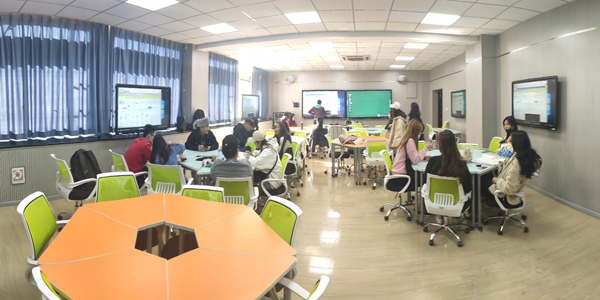

Quick answerIn the first half of 2026, a government and education project contractor in Southeast Asia won a public K-12 tender for 23 smart classrooms and completed handover roughly four months after submitting the bid. Each room was built around a 65-inch interactive flat panel with an OPS Windows module, a smart podium, and a ceiling camera for remote and dual-teacher lessons. Our part was the technical response behind the bid: a line-by-line compliance answer to the tender specification, a system topology, a full bill of materials, pricing support, and remote installation training.
We are not naming the contractor or the school. That is deliberate, and it is the same rule we apply to every project: we never contact a partner’s end client, and we do not publish their name. What is worth publishing is the transferable part — what the contractor actually needed in order to bid, how the four months were spent, and the one thing that went wrong on site that no specification sheet warns you about.
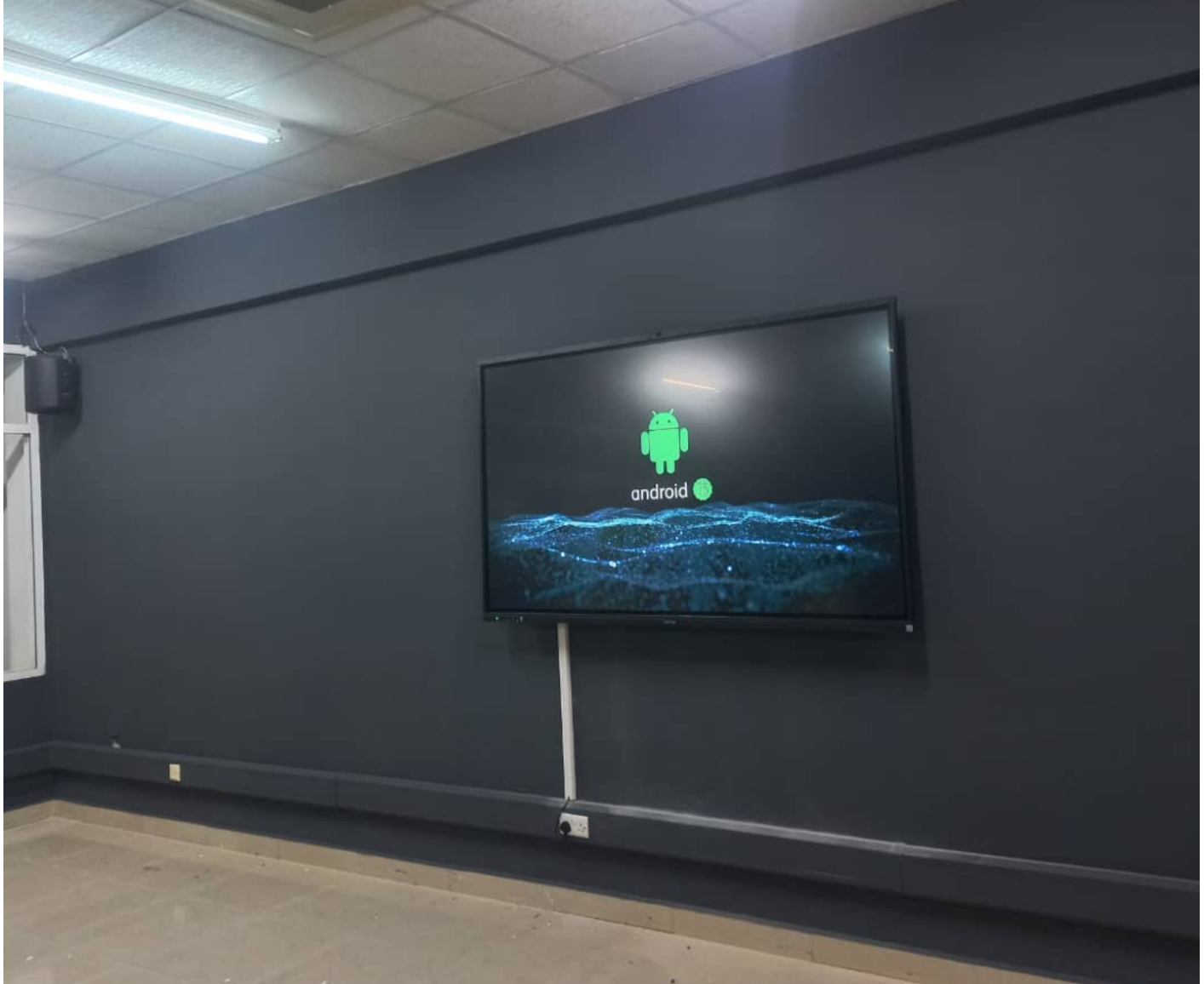
What was actually installed in each of the 23 rooms
The rooms were standard K-12 classrooms of roughly 24 seats, with the back row about four metres from the front wall. The configuration was identical in all 23 rooms, which matters more than it sounds: one configuration means one set of spares, one training session, and one installation method.
| Device | Role in the room | In this project |
|---|---|---|
| 65″ interactive flat panel | Main teaching display, touch input, Android | Yes — one per room |
| OPS computing module | Windows alongside Android, so the school runs its existing courseware | Yes — one per room |
| Smart podium | Teacher operating position; houses the PC, cabling and controls | Yes — one per room |
| Ceiling camera | Remote lessons and dual-teacher sessions between schools | Yes — one per room |
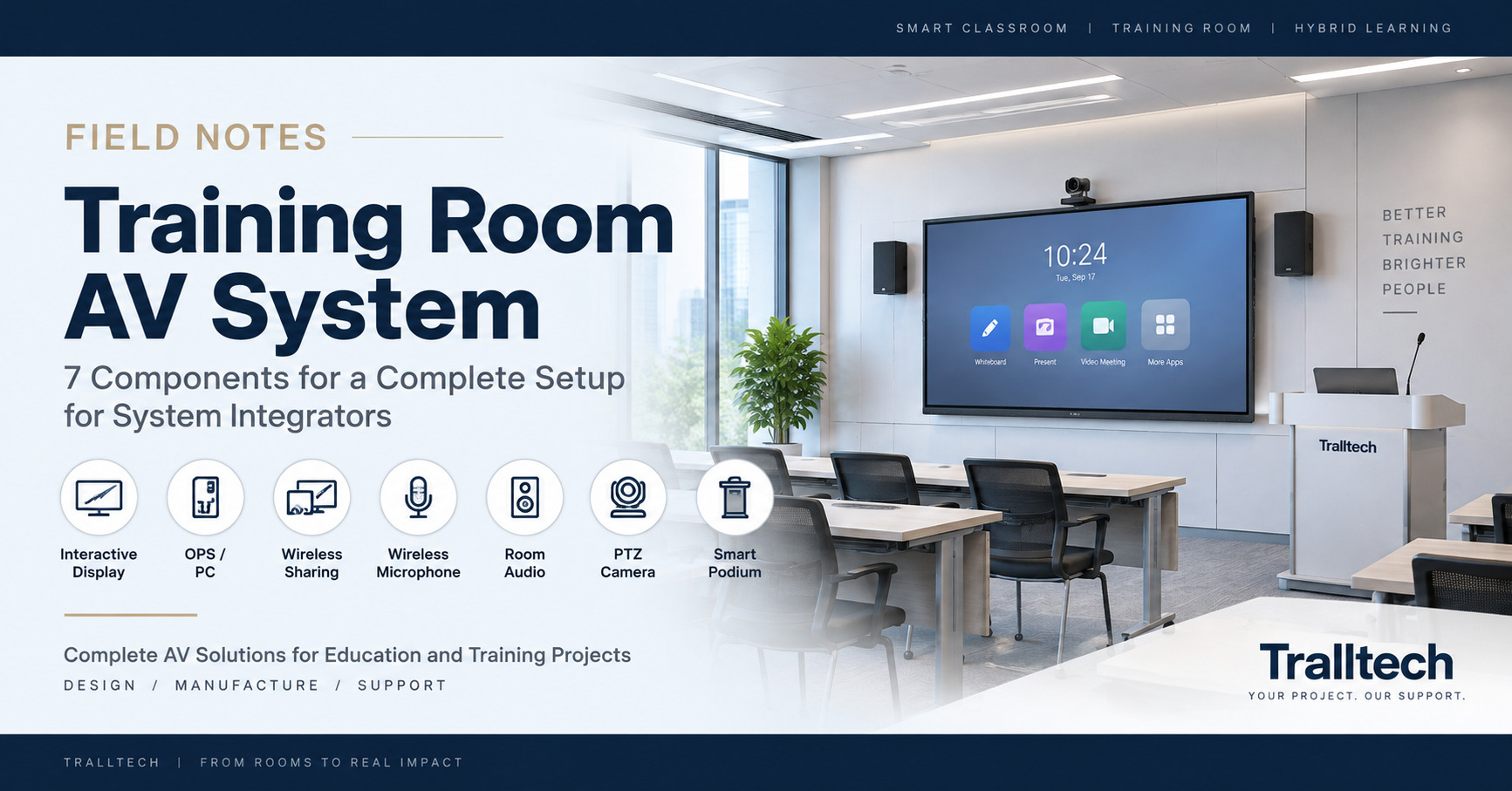
| Wireless microphone and wall speakers | Voice reinforcement and clean audio pickup | No — deferred to a later phase |
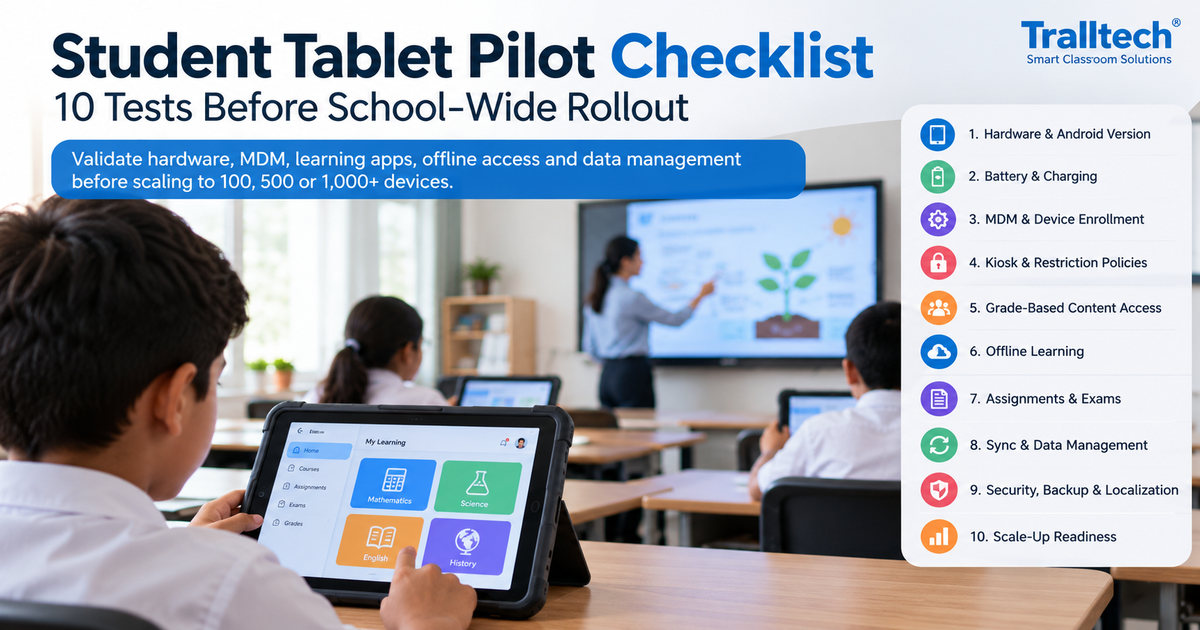
| Student tablets | One-to-one device learning | No — outside the tender scope |
The 65-inch size was not a budget compromise. With a back row around four metres away, 65″ sits inside the readable range, and going bigger would have added cost and mounting difficulty without adding legibility. In a project of this size, sizing every room to the same rule is what keeps the fleet consistent — the reasoning is set out in our guide to choosing interactive flat panel size for a classroom.
What the contractor actually needed — and it was not a price list
The contractor had the client relationship, the local licences and a delivery crew. What it did not have was an in-house AV design function. Its stated worry, from the first call to the day the results were published, was simple: can we actually win this?
So the work that mattered happened before the bid was submitted. The contractor sent us the tender’s technical requirements, and we returned four things:
- A compliance response — each technical requirement in the tender matched to a specific device and specification, line by line, so the evaluation committee could tick down the page without interpretation.
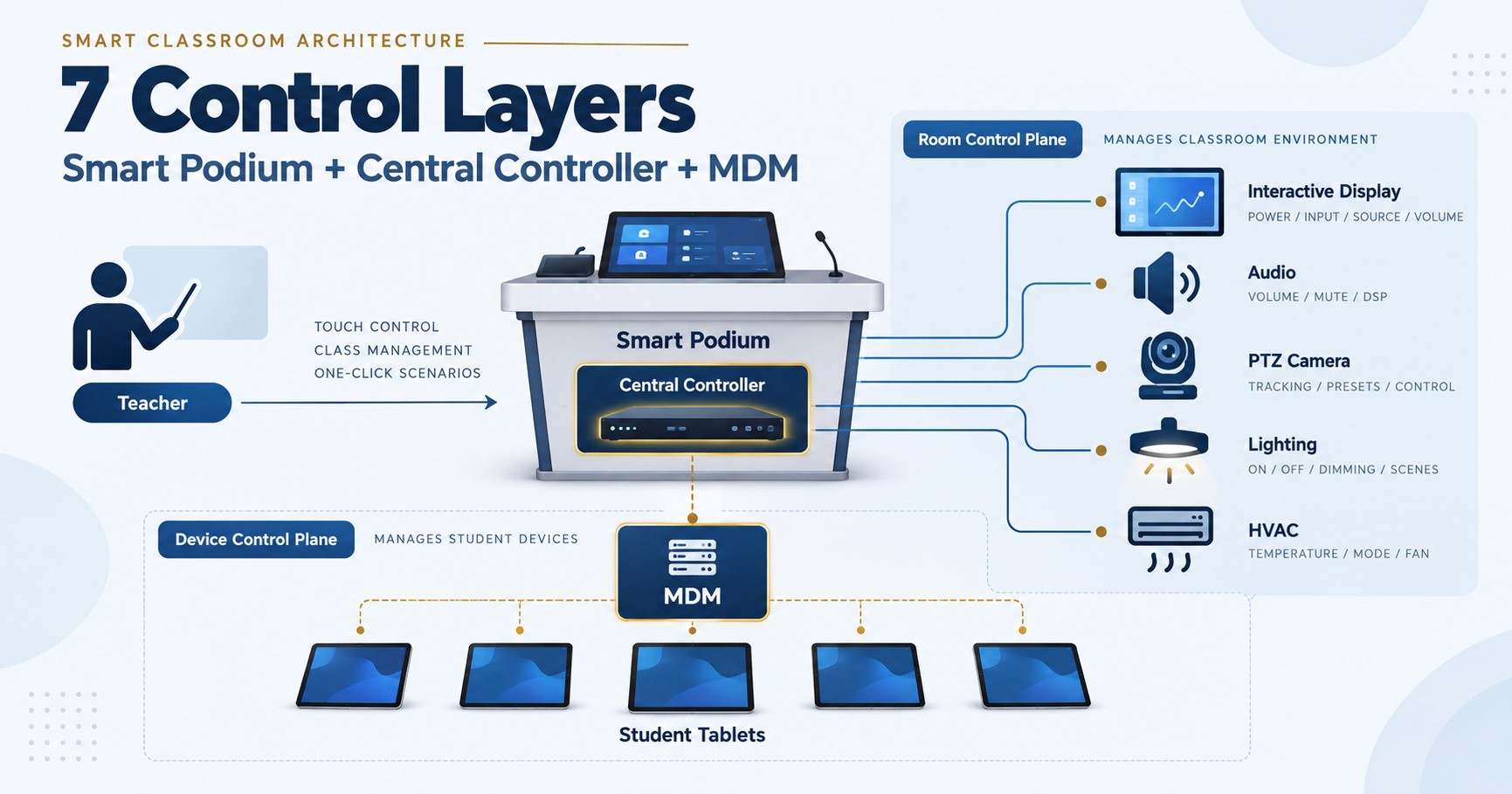
- A system topology diagram — how the panel, OPS, podium and camera connect in one room, and how a room connects back to the school network.
- A full bill of materials with quantities — not just the four main devices, but mounts, cables and accessories multiplied out across 23 rooms.
- Pricing support — factory-direct pricing early enough to be built into the bid, rather than quoted after the bid was already priced.
One detail is easy to miss in the timeline: the conversation with this contractor started the previous year, long before the tender documents existed. Public tenders are rarely won in the three weeks they are open. They are won by the supplier who was already answering questions when the project was still an idea — which is how the smart classroom solution we design for integrators is meant to be used: as engineering back-up during the bid, not as a catalogue after it.
The four months, stage by stage
Four months covered bid submission through to signed acceptance. Here is who did what.
| Stage | The contractor | Us, from the factory |
|---|---|---|
| Bid preparation | Assembled and submitted the bid; handled all client contact | Compliance response, topology, BOM, pricing |
| Award and order | Confirmed final quantities and room list | Locked the configuration; confirmed lead time |
| Production and shipping | Arranged import clearance and site readiness | Built, tested and packed 23 identical room sets |
| Installation and acceptance | Mounted, cabled and commissioned all 23 rooms | Remote installation guidance and teacher-training support |
The division of labour is the point. We never went to site, and we never spoke to the school. Installation is the contractor’s business, and it stays the contractor’s business.
What went wrong on site — and what we changed because of it
During installation, a panel was dropped and broken while being handled, and the installer was hurt. Nobody plans for this, and no datasheet mentions it. Two panels were shipped as replacements so the rollout could finish on schedule, without the two-week argument about liability that usually follows.
The practical lessons are worth more than the incident:
- A 65-inch panel is a two-person lift, always. It is a large sheet of glass in a rigid frame. It is not heavy in the way a crate is heavy; it is awkward, and the failure mode is sudden.
- Unbox at the wall, not at the door. Every metre a bare panel travels is risk. Carry the carton to the mounting position, then unpack.
- Fit the bracket and check the wall before the panel comes out of the box. Panels get broken while people improvise a fixing.
- Budget spare units into every multi-room project. On 20-plus rooms, one or two spares is not pessimism — it is the difference between finishing on time and waiting for a replacement shipment.
- Agree in writing who covers on-site damage before anything ships. Do it while everyone is still happy. It takes one paragraph in the order confirmation.
What we would add in the next phase
These rooms went in without dedicated audio — no wireless microphone, no wall speakers. That was a scope decision, and for ordinary front-of-class teaching in a 24-seat room the panel’s own speakers cope. The moment remote and dual-teacher lessons become routine, however, audio is the first thing that limits the room: a receiving classroom forgives a mediocre picture far more readily than it forgives a teacher it cannot hear clearly.
So the natural phase two is a wireless microphone for the teacher plus a pair of active wall speakers. One engineering point to keep in mind when quoting it: an interactive flat panel outputs a line-level audio signal, which cannot drive passive speakers on its own. Either the speakers are active, or an amplifier goes into the bill of materials. Getting that wrong is one of the most common ways a classroom audio upgrade ends up needing a second site visit.
Frequently asked questions
Can a contractor bid on a smart classroom tender without in-house AV design capability?
Yes, provided the manufacturer supplies the engineering layer. In this project the contractor held the client relationship and the delivery crew, while the compliance response, topology diagram and bill of materials came from the factory. That is a normal and legitimate division of work in public procurement: the bidder responds to the specification, and the manufacturer supplies the technical evidence behind the response.
Is a 65-inch interactive flat panel big enough for a classroom?
For a room of roughly 24 seats with the back row about four metres from the screen, 65″ is a sound choice. The working rule is that the farthest viewer should sit within about six times the screen height. Larger rooms, deeper seating or dense content push you to 75″ or 86″.
Who installs the equipment on an export project like this?
The local project company does. We ship, provide installation guidance and train the crew and teachers remotely; mounting, cabling and commissioning happen locally. It keeps costs realistic and it keeps the client relationship where it belongs — with the partner who won the project.
Key takeaways
- Twenty-three identical rooms — 65″ panel, OPS module, smart podium, ceiling camera — from bid to acceptance in about four months, with one configuration for the whole fleet.
- What decided the bid was not the price list but the compliance response, topology and BOM delivered before submission — and a conversation that had started a year earlier.
- Plan for breakage: two-person handling, unbox at the wall, one or two spare units on any 20-plus-room project, and a written line on who covers on-site damage.
Written by the Tralltech Technical Team · Last reviewed: August 2026
Related guides: How to Write Smart Classroom Tender Specifications · Interactive Flat Panel Lead Time: How Delivery Speed Wins Tenders · How to Choose the Right Interactive Flat Panel Size for a Classroom
Explore our solution: Smart Classroom Solution · 65-inch Interactive Flat Panel · OPS Computing Modules · Smart Podium