Quick answerA smart classroom costs more upfront than a projector setup, so buyers often wave a cheap projector quote to push your price down. The way to hold your margin and win the project is to move the conversation from day-one sticker price to smart classroom ROI — the total cost of owning and running the room over its full service life, where the projector’s low entry price is quietly eaten by lamps, maintenance, and a shorter lifespan.
It is a familiar moment. You have quoted a smart classroom, and the school or ministry comes back pointing at a projector-and-screen bid at a fraction of the price, asking why they should pay more. As the integrator, you cannot win that argument on sticker price — and you should not try to. You win it by reframing the decision around what the room actually costs to own and run over the years it stays in service. This guide shows how to build that case for a school or government buyer without overpromising or leaning on numbers you cannot defend.
What “ROI” really means in an education project
Schools and governments do not buy hardware — they buy outcomes. Return on investment is the total value a deployment returns measured against its total cost across the years it stays in service. That value lands in three buckets: financial (recurring cost savings), operational (staff time and device management), and educational (engagement, hybrid teaching, accessibility). The first two can be quantified; the third usually cannot be reduced to a single figure but still drives the decision.
Your advantage is knowing who is in the room. A capital-budget holder cares about total cost of ownership and payback. An education lead cares about teaching outcomes. Lead with the bucket that person is accountable for, and keep the others as supporting evidence.
Why a cheap projector quote is misleading
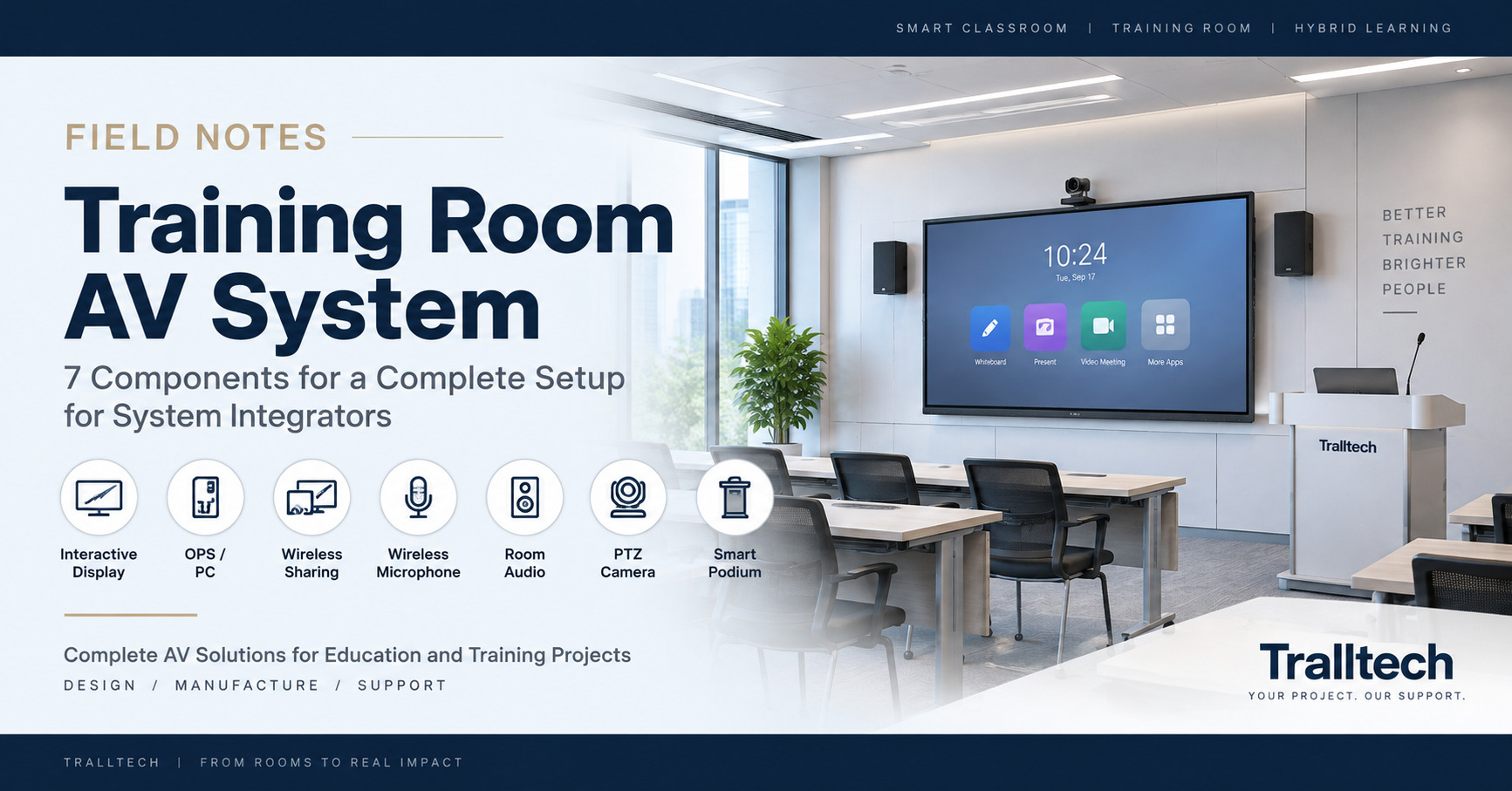
The projector’s sticker price hides the recurring spend that follows it. It also hides line items that an inexperienced bid leaves out: a projector classroom still needs amplified audio, cabling, and often a control system on top of the projector itself. Be equally honest about your own side — an interactive flat panel’s audio output is line-level, so it must feed an active speaker such as the T-AUD-ACT, not a passive one, and that belongs in the quote. Comparing a stripped projector bid against a complete smart-classroom quote is not a fair comparison; comparing the full lifecycle of each is.
| Cost factor | Projector / traditional | Smart classroom |
|---|---|---|
| Upfront equipment | Lower (projector, screen, separate audio) | Higher (IFP + OPS + active speaker) |
| Consumables | Ongoing (lamps, markers, printing) | Minimal |
| Maintenance | Lamp replacement, alignment, repairs | Lower; largely software-managed |
| Equipment lifespan | Brightness fades; lamps fail | Long panel life; 2-year warranty |
| Device management | Manual, room by room | Centralised (MDM / OTA across rooms) |
| Teacher prep time | Higher (manual setup, re-made materials) | Lower (digital, reusable, shareable) |
The pattern is consistent: a projector setup front-loads a low purchase price and back-loads recurring spend, while a smart classroom does the reverse. Whether the lines cross within the client’s budget horizon depends on their real consumable and maintenance spend — which is exactly why you ask for those figures rather than guessing.
Where the returns actually come from
Most of the return is recurring, not one-off:
- Reduced consumables — no projector lamps, no markers, far less printing.
- Lower maintenance — no bulb cycle and fewer moving parts; many issues are fixed in software rather than with a site visit.
- Teacher efficiency — lessons are reusable, setup is faster, and content is shared across classes.
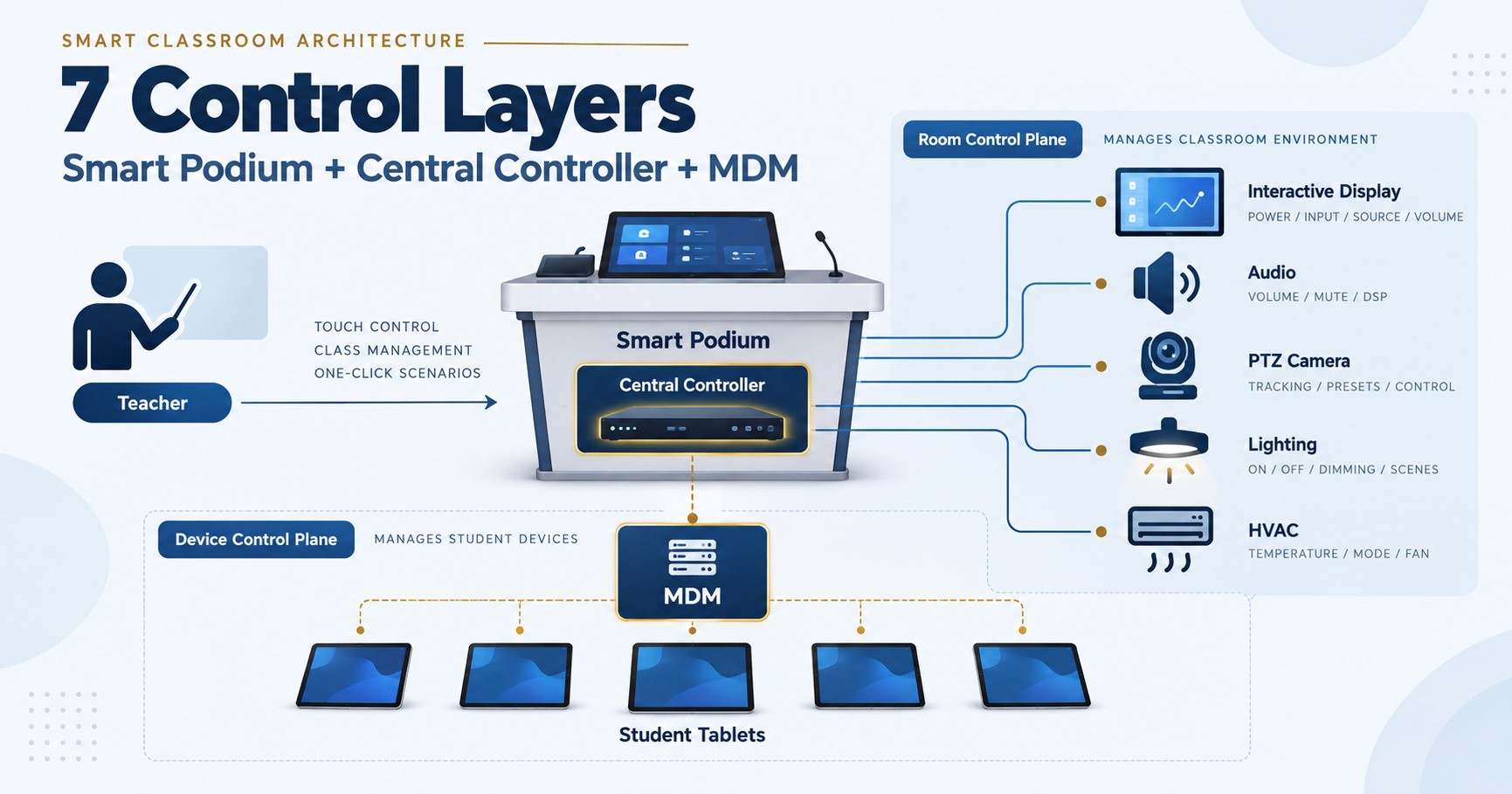
- Management at scale — with device management and over-the-air updates you can push a launcher, policy, or update to a couple of hundred rooms at once instead of sending a technician to each. The saving grows with every room, which is what makes multi-school bids profitable.
- Hybrid and remote capability — the same room supports in-person and online teaching, protecting continuity.
- Future-proofing — education AV is shifting away from projectors toward interactive displays, so a projector bought today risks an earlier forced upgrade.
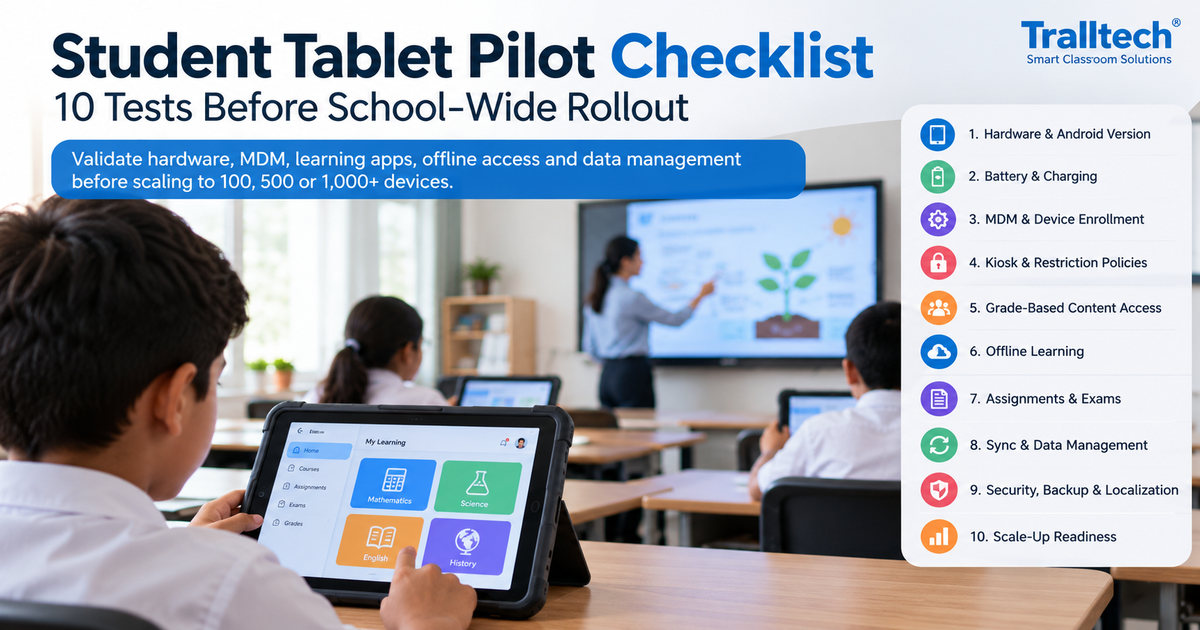
For low-connectivity projects the ROI takes a different and often better shape. A local content server running Kolibri, with device management for the tablets and panels, delivers digital learning with no recurring bandwidth cost — a strong case for rural and donor-funded deployments. See the offline education solution for how that is built.
How to answer the “but the projector is cheaper” objection
- Don’t compete on sticker price. Put both options on a multi-year total-cost view and let the recurring spend make your argument.
- Use the client’s own numbers. Build the case from their actual lamp, maintenance, and printing spend rather than invented statistics — buyers see through inflated figures, and your own data is more persuasive anyway.
- Phase the rollout. Staging a deployment in levels lets the client spread capital and start seeing returns early instead of one large commitment. See the smart classroom solution levels.
- Match the tier to budget and connectivity. If the budget genuinely will not stretch, an offline-first or entry deployment can deliver outcomes without recurring costs — a better fit than losing the project entirely.
- Do not gut your own quote to match a naive bid. Dropping the active speaker, the PoE switch the wireless AP needs, or proper mounting just to hit a number will either kill your margin or your credibility when the room underperforms. Quote the room that actually works, and explain why each line is there.
Frequently asked questions
A client is comparing my smart classroom quote to a cheaper projector — how should I respond?
Do not compete on the entry price. Reframe the comparison around total cost of ownership over the room’s service life, built from the client’s own lamp, maintenance, and printing spend, and add the management and longevity gains a projector cannot match. In most cases the projector’s low sticker price is offset within the lifecycle.
How long is the payback period for a smart classroom?
There is no universal figure — it depends on how much recurring spend the deployment replaces, how many rooms share centralised management, and which tier is chosen. Calculate it from the client’s current costs, and remember a phased rollout shortens the time to first value.
How do I justify smart classroom ROI to a government or NGO buyer?
Lead with total cost of ownership and measurable operational savings, present educational benefits as supporting value, and propose a phased, standards-compliant (CE / FCC / RoHS) deployment that fits the budget cycle. For grant- or donor-funded projects, emphasise predictable lifecycle costs and low ongoing dependency.
Key takeaways
- When a buyer uses a cheap projector bid to push back, don’t compete on sticker price — reframe to total cost of ownership over the room’s full life, where the projector’s entry price is offset by lamps, maintenance, and a shorter lifespan.
- The durable returns are recurring and scale with size: fewer consumables, less maintenance, and centralised MDM / OTA that pays off across every added room.
- Quote the room that actually works — active speaker, PoE for the AP, proper mounting — and build the case from the client’s own numbers; cutting line items or inflating stats to win the bid costs you later.
Written by the Tralltech Technical Team · Last reviewed: June 2026
Related: Smart Classroom Solution · Offline Education Solution · What Is an Interactive Flat Panel?