Quick answerWe read three unrelated public tenders for education and enterprise AV — a UN agency procurement, a development-bank-financed national programme, and a corporate refurbishment. They contained almost the same tender specification mistakes: a competitor model number left in a “generic” requirement, an operating system copied from an obsolete datasheet, memory written as a range instead of a minimum, a mandatory OPS slot with no OPS module budgeted, and two cameras specified for one room. None of these are exotic. All of them are catchable before you bid.
Our companion guide covers how to write smart classroom tender specifications properly. This article is the other half of the picture: what actually shows up in published documents, and what an integrator should do about it.
The three documents came from different funders, different countries and different sectors. The overlap in their errors is the interesting part. When three unrelated buyers make the same mistakes, it is not carelessness — it is a structural feature of how procurement documents get assembled: someone opens a manufacturer datasheet, pastes the specification table, edits the parts they understand, and leaves the rest.
Five errors that appeared in all three documents
| What the document said | Why it breaks | What to do before the question deadline |
|---|---|---|
| A screen size range, then a specific competitor model number quoted at a third size | Left over from the source datasheet. Bids get compared against a brand nobody intended to mandate | Ask in writing whether the model reference is indicative or mandatory |
| Operating system fixed to a specific older Android release; storage fixed at a figure typical of much older panels | Complying literally means shipping outdated hardware into a multi-year deployment | Propose “equivalent or later” wording and attach the reasoning as a technical note |
| Memory and storage written as a range rather than a minimum | Whoever quotes the bottom of the range wins on price, and the room ages badly | Request the range be restated as a minimum, or state clearly which end you quoted |
| An OPS slot listed as mandatory, with no OPS module anywhere in the bill of materials | The room is specified to accept a Windows module nobody budgeted for; users find the gap after handover | Quote the slot as required and offer the module as a clearly separated optional line |
| A panel specified with a built-in camera, plus a separate tracking camera at the same quantity | Two cameras per room, two USB paths, and an argument at commissioning about which one the software should use | Confirm the intended primary source; propose deleting the duplicate and moving the budget to audio |
The camera duplication is worth dwelling on. Large-format panels increasingly ship with an integrated camera and microphone array — our own 110-inch panel does. When a specification pairs that panel with a separate tracking camera one-to-one, two vendor datasheets have been merged without anyone noticing the overlap. Catch it and it is budget you can redirect into the part of the room that was under-specified. Miss it and it is scope you absorb.
One document contradicted itself three times about screen size
In the development-bank-financed tender, the narrative section named one diagonal, the compliance table stated a different minimum, and the bill of materials listed a third figure. Three numbers, one document, all mandatory-looking.
This is not unusual in documents assembled by several people over several weeks. What matters is that you do not silently pick one. Whichever figure you quote, an evaluator reading a different section can mark you non-compliant. Raise it as a clarification question so the buyer issues an amendment for all bidders, and keep the written answer with your bid file. If no amendment comes, quote to the strictest of the three and state your interpretation explicitly in the technical response.
The audio chain was incomplete in every one
All three stopped at built-in panel speakers. In one, student microphones were specified with an XLR receiver output — and nothing anywhere in the bill of materials had an XLR input.
The underlying reason is a physical fact that specification writers routinely miss: the audio output on an interactive flat panel is line level. It is designed to feed an active speaker or an amplifier, not a passive speaker directly. If the document does not name amplification, the audio chain is incomplete no matter how impressive the microphone specification looks. We cover the full signal path in our classroom audio system design guide.
The same pattern appeared on the network side. One document required cameras with Ethernet and PoE at meaningful volume, while the only network device in the entire bill of materials was a consumer-grade router with four LAN ports. No PoE switch, no budget for one. Decide explicitly whether that switch is in your scope or the client’s, and write the decision into your bid — “it was obvious” is not a position you can defend at commissioning.
Three procedural traps that eliminate bidders before technical scoring
- Manufacturer authorisation. All three required an authorisation letter, and some required a multi-year spare parts commitment alongside it. The constraint is never willingness — it is lead time. Request authorisation the day you decide to bid, not the week it is due.
- Compulsory site inspection. The corporate tender stated plainly that bidders who did not attend the pre-bid inspection would be deemed non-responsive. No local presence, no bid, regardless of price or product. This is one structural reason the integrator, not the factory, must be the entity that bids.
- Conflict-of-interest disclosure. Donor-funded tenders commonly require bidders to disclose whether they or any affiliate helped prepare the specifications for that procurement. Helping a client’s technical team draft a specification can therefore affect your own eligibility. Read that clause before you offer the help, and structure who does what accordingly.
- And one liability clause. One document stated that the bill of materials was a minimum estimate, that bidders must survey the sites themselves, and that the client accepted no liability for omissions. That transfers every gap above onto you. Treat the BOM as a starting point, not a scope.
What happens when an integrator sends us a tender
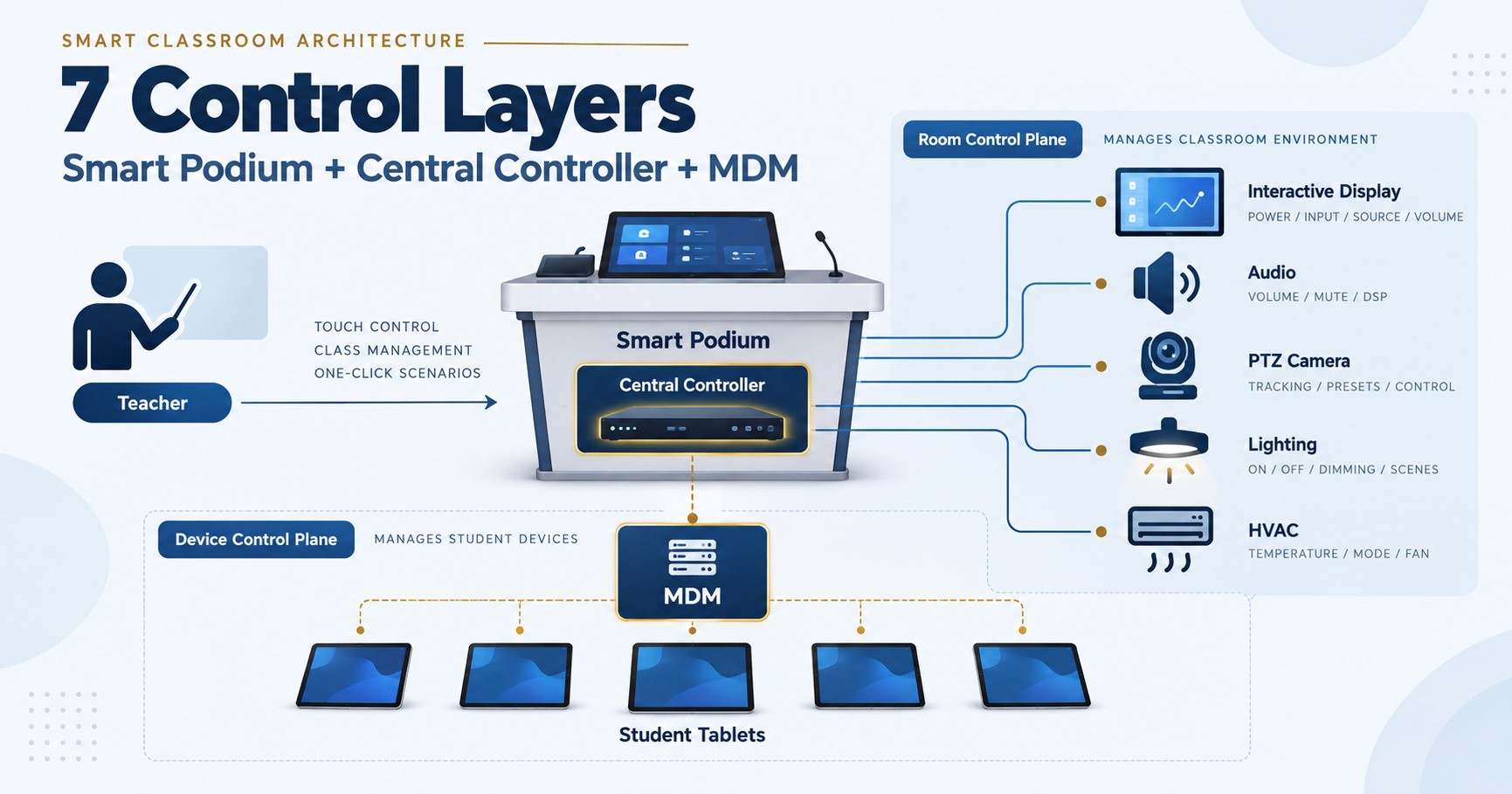
This is the working method behind everything above. An integrator forwards us the specification; we map it line by line against what we manufacture. Because the product line spans displays, podiums, computing modules, audio and tablets, most smart classroom tenders can be answered from stock. Where a requirement falls outside it, we source from partner factories; where a stated parameter has no off-the-shelf match, we can build to it. In practice that covers the large majority of classroom projects — and just as importantly, it means we can tell an integrator early which lines are genuinely unmeetable rather than discovering it after the bid is submitted.
We write the specification notes, the corrected bill of materials and the topology drawing. The integrator submits the bid and owns the client relationship. We never contact end clients. Given the conflict-of-interest clause above, that division is not only a commercial preference — it keeps the eligibility question clean.
Frequently asked questions
Should I point out errors in a published tender, or quote around them?
Raise genuine errors as written clarification questions before the question deadline, when the buyer can still amend the document for every bidder. Quoting around an error silently is the risk: an evaluator comparing your offer against the literal text can mark it non-compliant. Anything unresolved belongs in a clearly labelled deviations annex, never as a quiet substitution.
Does an outdated specification mean I have to supply outdated equipment?
Not usually, but you cannot assume it. Offer current equipment as your primary compliant response, explain in functional terms why it meets or exceeds the stated requirement, and ask the buyer to confirm “equivalent or later” wording. Where the buyer refuses to amend, price both and let them choose in writing.
Who pays when the bill of materials turns out to be incomplete?
Usually the bidder. Tender documents frequently state that the BOM is a minimum estimate, that bidders must survey the sites themselves, and that the client accepts no liability for omissions. Survey properly where site access is offered, and price the missing interfaces rather than hoping they were someone else’s job.
Key takeaways
- The same specification errors recur across unrelated buyers and funding sources, because tenders are assembled item by item rather than along the signal chain.
- Check first for leftover model numbers, ranges written instead of minimums, mandatory slots with no module, duplicated cameras, and an audio chain with no amplification.
- Manufacturer authorisation, compulsory site inspections and conflict-of-interest clauses eliminate more bidders than technical scoring does.
Written by the Tralltech Technical Team · Last reviewed: July 2026
Related guides: Smart classroom tender specifications · Smart classroom equipment list · Classroom audio system design
Explore our solution: Smart Classroom Solution